

Bridging the Gap Between Traditional and Digital Channels
In the fast-paced world of 2026, the “Digital vs. Traditional” debate is officially dead. Whether you’re a fresh Marketing Manager, an Aussie tradie with a growing crew, or a partner at a professional services firm, the goal remains the same: relevance.
Today, successful brands don’t choose one over the other; they blend them. To build a business that lasts, you must understand where your audience lives, works, and plays – both on their screens and in their physical world.
This guide breaks down the core channels dominating 2026 and demonstrates how to use them to drive tangible business sustainability.
Traditional Marketing Channels: The Power of Physical Presence
Traditional marketing involves offline channels that reach people in their physical environments. In an era of digital fatigue, traditional channels often carries a higher sense of durability and trust.
Why It Still Works
For a lawyer, a physical presence builds prestige. For a tradie, a branded truck is a rolling billboard that builds local social proof, every time it’s parked in a driveway.
3 high-impact traditional marketing channel examples:
1. Vehicle Signage & Branded Workwear
The Tradie Special.
Your Ute or Van isn’t just transport; it’s your best lead generator. High-visibility branding with a clear QR code, linked to your latest project gallery, is an example that bridges the gap between the physical and digital world.
2. Localised Print & Direct Mail
While junk mail is ignored, high-quality, personalised community updates or neighbourhood postcards work wonders for local services.
In practice this could be a local law firm sending a “Know Your Rights” mini-guide to residents in their specific suburb, related to common ‘rights’ for the area.
3. Sponsorship & Community Events
Supporting the local footy team or a community festival is not just about the logo on the jersey, it’s about being the first name people think of when they need a reliable plumber or legal advice.
Digital Marketing Channels: Precision, Scale, and Data
Digital marketing encompasses everything seen on a screen. In 2026, this is powered by AI-driven personalisation and first-party data.
Why It’s Essential
Digital channels allow for Search Intent marketing. You aren’t just shouting at a crowd; you are appearing exactly when someone types “emergency electrician near me” or “best family lawyer in Brisbane” into a search engine.
3 High-Impact Digital Channel Examples:
1. Search Engine Optimisation (SEO) & Local Search: This is non-negotiable. SEO ensures your website is the answer to your customer’s questions.
When your website is optimised for SEO, the key words that relate directly to your industry, location and expert skills, sets your website up to appear on the first page of the used search engine like Google or Safari. The structure of how keywords are designed into your business services or product pages is the core skill of a good copywriter.
For example: Creating a blog post titled “5 Things to Check Before Hiring an Electrician in Sydney” to capture local leads.
Blogs and articles are forms of ‘long form copywriting’ which not only helps boost your digital credibility with the algorithms, AI-Assistants and AI search platforms, but also organic search rankings.
2. Short-Form Video Content (Social Media): Platforms like TikTok and Instagram Reels are now search engines in their own right.
Creating A “Day in the Life” video of a legal clerk explaining a complex concept in 60 seconds builds massive authority and humanises legal profession.
3. Email Marketing & Automation:
- Once you have a contact, email is your way of staying top-of-mind and converting the contact into a paying client. Email marketing is still the number one sales channel small businesses can effectively use, at a relatively low cost, to keep a consistent flow of paying clients.
- Example: A monthly “Home Maintenance Tip” email for a plumbing business that includes a “Book an Inspection” button.
Regular emails or newsletters using the concept of the example is a strategy every small business should include as part of running their business. I know that for many small businesses with the pressure of keeping the lights on for themselves and their employees is already the core goal. And the thought of committing to creating regular emails to keep existing clients coming back or convert an interested potential client, seems all too much – even with all the AI hype of getting it to do it for you.
Partnering with an experienced copywriter that will take the time to know your business and your audience will take the stress out of the strategy and will pay you back with a consistent flow of the right clients while you sleep – over and over again.
The Hybrid Strategy: Why Businesses Need Both
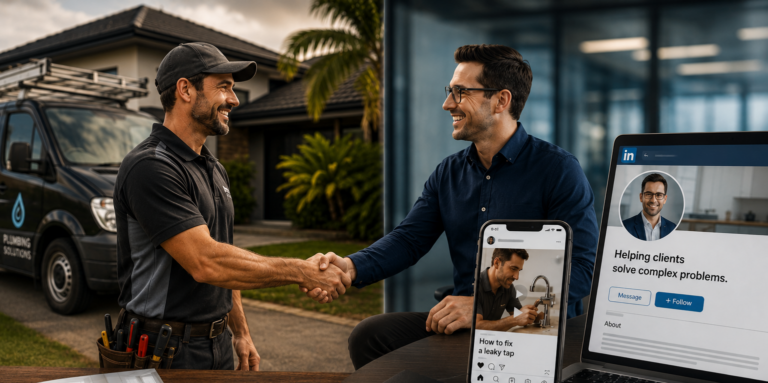
Think of traditional marketing as the handshake and digital marketing as the follow-up.
If a homeowner sees your branded Ute, the traditional marketing channel, and then later sees an educational video of you fixing a leaky tap on their Instagram feed, the digital channel, it exponentially build the trust.
For professional services, an ad in a professional journal or association magazine, traditional channel, paired with a high-authority LinkedIn profile, digital channel, establishes you as the expert in your field.
What Local Buyers Actually Search For in 2026
If you run a plumbing business, electrical company, law firm, accounting practice, or consultancy, most of your best leads are not searching for marketing. They are searching for solutions. They type phrases such as “blocked drain plumber near me”, “commercial electrician Sydney”, “family lawyer Western Sydney”, or “small business accountant Melbourne”. That is why your content needs to match real buyer language, not industry jargon.
The businesses winning in 2026 are the ones that answer local questions clearly, show proof of experience, and make it easy for people to call, enquire, or request a quote or meeting on the spot.
For local trades and professional services, one generic services page is rarely enough. You need strong service pages and location relevance. That means dedicated pages for your core offers, supported by useful articles that answer common questions in your market.
A concreter in Newcastle might publish pages for driveways, shed slabs, and exposed aggregate. A law firm might build separate pages for family law, conveyancing, wills, and commercial advice. When these pages also reference service areas, common client concerns, timelines, and outcomes, they become far more useful to both search engines and real people.
How to Be Found: SEO and GEO in Plain English
In 2026, being found online is no longer just about ranking on Google. It is also about being referenced in AI-generated answers and search summaries. Traditional SEO helps your website appear in local search results, map listings, and service-based queries. GEO, or generative engine optimisation, helps your business become the kind of source AI Assistants can quote, summarise, and recommend.
For a local business, that means your website copy must be clear, specific, trustworthy, and genuinely useful. Vague fluff will not cut it anymore. Strong local pages, detailed FAQs, review signals, and experience-led content all improve your visibility across both standard search and AI search platforms.
A practical approach is simple. First, fully optimise your Google Business Profile with correct categories, service areas, photos, recent updates, and review activity. Second, keep your business name, address, and phone details consistent everywhere online. Third, publish suburb-aware service pages and articles based on real client questions. Fourth, structure your content so it is easy to scan: use clear headings, concise paragraphs, lists where helpful, and direct answers near the top of the page.
Finally, back up your claims with specifics such as years of experience, service process, turnaround times, and case examples. These trust signals matter for humans, for Google, and increasingly for AI search platform experiences.
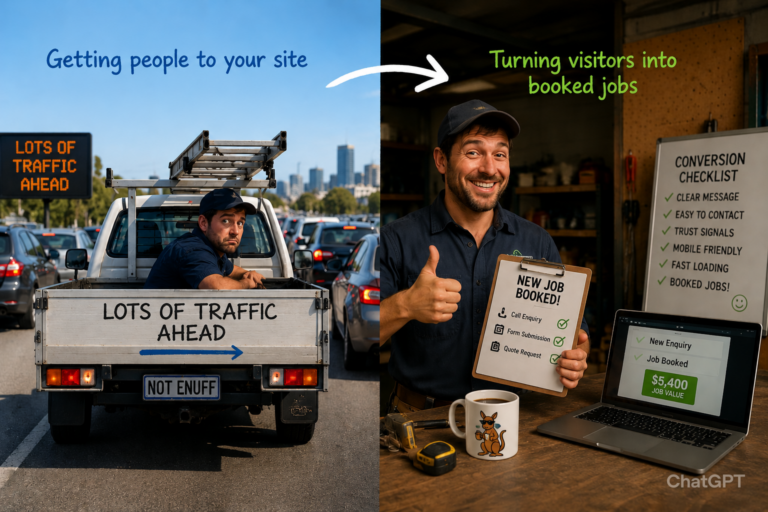
Traffic Is Only Half the Job: Your Website Must Convert
More website traffic is valuable only if your website turns visitors into phone calls, quote requests, and booked consultations. This is where many businesses lose revenue. They invest in SEO, social media, or Google Ads, then send prospects to pages that are slow, vague, or hard to act on. A local services website should make the next step feel obvious. Your phone number should be easy to find when the reader is on their mobile. Using Click-to-Call functionality makes it even easier.
Your contact form should be short enough to complete in under a minute. Your call-to-action should tell people exactly what happens next, whether that is a same-day call back, a fixed-fee consultation, or a free site visit.
For tradies, trust often comes from speed, proof, and clarity. Show recent jobs, explain your process, list the suburbs you service, and answer practical questions such as response times, licences, insurance, and payment options.
For professional services firms, trust usually comes from authority, reassurance, and next-step clarity. That means strong staff profiles, clear service explanations, common client scenarios, and content that reduces uncertainty before the first call.
In both cases, every page should guide the reader towards an action: call, enquiry, book or purchase. If a visitor has to hunt for your number or wonder whether you are the right fit, you will lose them to a competitor who simply makes it easier for them to get closer to the solution they need.
The best-performing content is usually not clever; it is useful. Write articles that answer the questions people ask before they are ready to hire. For example: “How much does a switchboard upgrade cost?”, “When do I need a conveyancer?”, “What should I ask before hiring a bookkeeper?”, or “Do I need council approval for this renovation?” These topics bring in qualified traffic or ‘warmer’ leaders because they sit close to the decision-making stage. They also create stronger SEO and GEO signals because they are factual, location-aware, and aligned with real search intent.
The bottom line is this: if you want more website traffic and more enquiries in 2026, your marketing has to do two jobs at the same time. It needs to attract the right people through local visibility, and it needs to convert them through trust-building copy and friction-free next steps.
For trades and professional services firms, that means showing up locally where your audience is playing and living, on screen and off. Sounding human, proving credibility, and making it easy to get in touch.
When those pieces work together, your website stops being an online brochure and starts acting like a reliable business development tool and your social posts not only entertain but drive potential clients to your website.